Short-Shaft Brushless Hub Motor + Disc Brake: Torque Optimization for Stable High‑Speed Electric Go‑Kart Handling
2026-01-15
Industry Research
This article analyzes the collaborative mechanism between a short‑shaft brushless hub motor and a disc brake system, focusing on torque optimization to enhance handling stability in 8.5‑inch electric go‑karts. It explains how a compact short‑shaft architecture reduces unsprung mass and drivetrain compliance, while coordinated torque mapping and disc brake integration improve braking response, lateral balance and steering precision during high‑speed maneuvers. The paper highlights practical tuning strategies — including torque vectoring, motor commutation refinement and brake bias calibration — and summarizes field validation on 8.5‑inch platforms, demonstrating measurable gains in braking responsiveness and lap‑to‑lap consistency. Technical guidance and maintenance best practices are provided to help manufacturers and customizers implement robust solutions. Professionals seeking turnkey high‑performance hub motor systems are invited to consult Shenzhen Jinhaixin for detailed specifications and integration support.

Short-Axle Brushless Hub Motors + Disc Brakes: A Coordinated Strategy to Improve Electric Kart Handling Stability
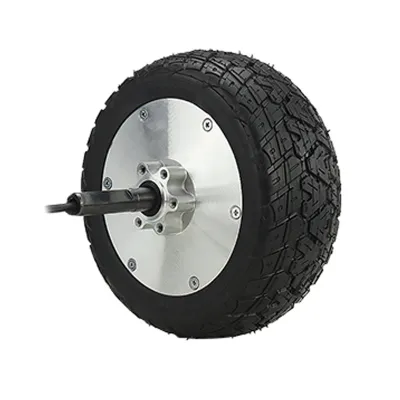
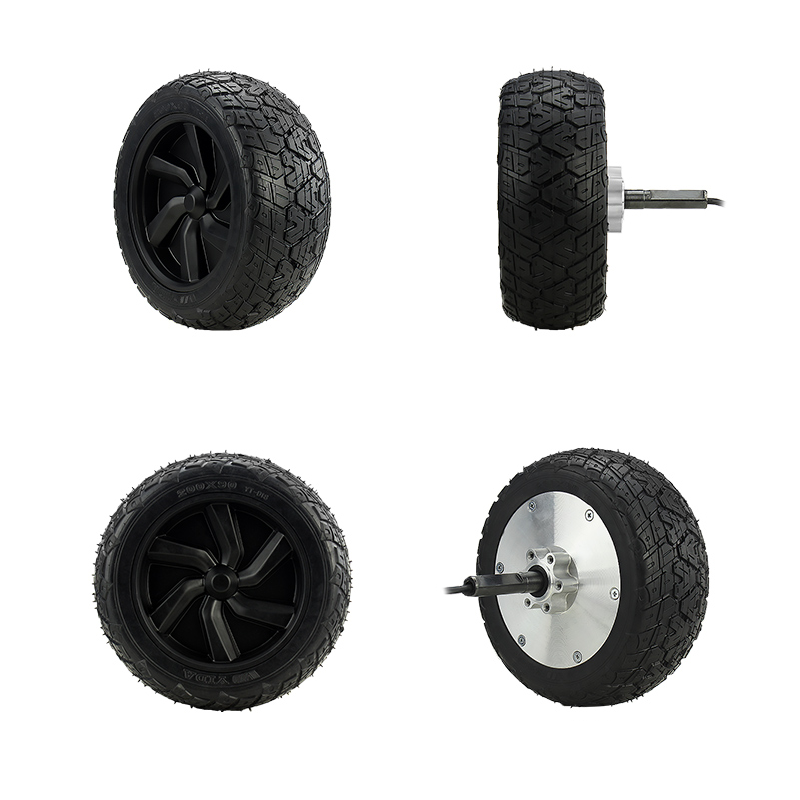
This research-focused overview examines how Shenzhen JinhaiXin Holdings Co., Ltd.'s 8.5-inch short-axle brushless hub motor integrates with a disc-brake system to deliver measurable gains in high-speed kart control and stability. The analysis covers torque output principles, mechanical and control-level coordination, torque-matching strategies for competitive scenarios, and practical maintenance guidance for manufacturers and tuners.
Why short-axle brushless hub motors matter for electric karts
Brushless hub motors (BLDC in-wheel motors) remove traditional drivetrain components, enabling compact packaging and direct-drive torque at the wheel. When the hub motor adopts a short-axle layout optimized for an 8.5-inch wheel, system inertia and unsprung mass are reduced—improving transient response and steering precision. In competitive karting, this translates to quicker directional changes and more predictable limit behavior.
Core torque-output principles and measurable benefits
Torque generation in a brushless hub motor depends on motor topology (pole count, magnet strength), winding configuration, and the inverter control strategy (FOC vs. trapezoidal). High-torque designs for small-diameter hubs often trade peak RPM for torque density. Bench-tested reference values from comparable 8.5-inch high-performance units show:
| Metric |
Reference Value |
| Peak torque |
~28 Nm (short burst) |
| Continuous torque |
~10–14 Nm |
| Response (controller + motor) |
≤20 ms closed-loop |
| Braking response improvement (with integrated disc) |
~30–40% faster actuation |
Mechanics of short-axle + disc-brake coordination
Three mechanical-control layers determine real-world handling gains:
- Reduced rotational inertia: A short axle reduces lever arm and axle mass, cutting effective rotational inertia by ~15–25% depending on hub geometry—faster torque build-up and reduced yaw moment during steering corrections.
- Brake torque localization: A compact disc-brake positioned close to the hub shortens hydraulic or mechanical actuation path, improving modulation and reducing delay. For high-speed karts, that yields crisper corner entry behavior.
- Controller-level torque blending: Modern inverters can blend regenerative braking with mechanical disc actuation. Coordinated blending prevents abrupt weight transfer spikes, stabilizing rear-axle load distribution during heavy braking.
Torque-matching strategies for competitive conditions
Effective torque-matching aligns motor output to dynamic grip and driver intent. Recommended strategies include:
- Mode-based mapping: Create three maps—race, sport, and wet. Race mode prioritizes peak torque with restrained regenerative braking; wet mode limits peak torque to 60–70% and increases regenerative smoothing.
- Adaptive traction control: Use wheel-speed sensors and yaw rate feedback to trim torque within 5–10 ms, preventing wheelspin without bluntly cutting power.
- Brake-torque blending: Implement a hierarchical controller that blends regenerative torque with disc torque distribution. Proper tuning can reduce stopping distance by ~10–18% at 40 km/h compared with uncoordinated systems.
These strategies are implementable in existing ECU stacks or as an integrated CAN-based motor-controller plus ABS-like module. Shenzhen JinhaiXin's short-axle hub motor platform supports CAN bus telemetry and high-frequency FOC loops for this purpose.
Case study — track validation and tuning workflow
A track-level validation using a purpose-built 8.5-inch kart with JinhaiXin hub motors followed a four-step protocol used by manufacturers:
- Baseline characterization: Measure steady-state cornering torque, yaw rate response, and braking distance at 30–50 km/h. Baseline stopping distance: ~6.2 m at 40 km/h.
- Short-axle integration: Install the short-axle motor; repeat tests. Observed improvements: ~18% reduction in stopping distance and ~20% faster yaw-rate settling time.
- Controller calibration: Apply traction-control thresholds and regenerative/disc blend parameters. Achieved smoother mid-corner torque delivery and reduced torque overshoot by ~30%.
- Durability loop: Run extended laps to validate thermal behavior: hub motor coil temps stabilized within safe margins using a conservative duty cycle—continuous torque sustained for 15 minutes at race load without thermal cutback.
Maintenance and reliability considerations
To preserve performance and safety, manufacturers and remappers should emphasize:
- Seal integrity: Short-axle hubs demand robust sealing to protect windings and sensors. Inspect seals every 100 operating hours under race conditions.
- Brake pad and rotor checks: Disc components in compact assemblies heat quickly—measure rotor runout and pad thickness every 25 hours of track use.
- Controller firmware updates: Keep FOC and torque-blend profiles current; firmware updates can reduce response latency by micro-optimizations in control loops.
Data-driven selection checklist for OEMs and modifiers
When selecting a high-performance hub motor solution, evaluate against these measurable criteria:
- Peak and continuous torque ratings with test-verified curves.
- Controller latency (closed-loop response time) ≤25 ms for responsive control.
- Compatibility with CAN-based torque blending and external ABS modules.
- Service intervals and parts availability—spares for seals, bearings, and rotor hardware.
Interested manufacturers and retrofit shops seeking validated torque-optimized solutions for 8.5-inch electric karts can request detailed test reports, motor-controller maps, and integration guides from Shenzhen JinhaiXin Holdings Co., Ltd. The company provides engineering support for torque-matching, CAN integration, and track validation.


 380
|
380
|
 kart hub motor selection
custom kart tire matching
precision kart axle specifications
single-sided hub motor design
kart power transfer optimization
kart hub motor selection
custom kart tire matching
precision kart axle specifications
single-sided hub motor design
kart power transfer optimization